
目录
了解InnoDB的物理存储可以为后续进一步了解其日志存储打下基础。在前述的内容,较为详细的介绍了InnoDB内部的B+-Tree存储,本文在此基础上,继续介绍,一个B+-Tree的节点(经常称作“页面”)中,如何存储单条记录的。本文,仅介绍其一般实现,并不对InnoDB记录格式的各种类型、场景做详细介绍。
这部分倒没有什么复杂的理论的,更多的是一些实践经验以及实际应用场景中各种情况的考虑与适配。
最为直接的,则是按照“数据表”各个列的元数据顺序排列即可。而事实上,这也是InnoDB实现的基本原则。但在实践中,还有很多的问题要去解决:
- 总是要考虑存储与读取效率:存储空间尽量不要有浪费,这样可以保持单个页面存储更多的数据,则有更高的磁盘和内存的利用率。例如,需要考虑
Default值如何存储?NULL值如何存储?变长字段如何存储?超大的字段如何存储等。 - 如何较为便捷的实现各种类型的
DDL,例如新增一个字段、删除一个字段等
一条记录分为两个部分,Record Header
1. 准备测试数据
这里新建表,并写入两条新的数据:
DROP TABLE IF EXISTS t_r;
CREATE TABLE t_r (
  id int auto_increment primary key ,
  nick varchar(32),
  birthday date,
  password_hash char(32),
  email varchar(32)
);

INSERT INTO t_r VALUES
  (1,"zzx","1989-02-11","a76e5fc27899ada11b4eafd0b1a7a4fc",'zzx@example.com'),
  (2,"yhq","2012-05-18","b6bdc8dcddeacece09d5697145d373d9",'yhq@example.com')
;(注:最好不要这样存储hash值)
2. 找到数据页
这需要一些背景知识,但并不是本文介绍的重点。在独立表空间(当前MySQL的默认行为)的情况下,:
- 在数据目录下找到表数据文件:
db.t_r.ibd - 查看该页面的第四个
Page即为第一个数据页面,因为这里写入的数据较少,所以,一般就存储在该页面
2.1 为什么是第四个页面
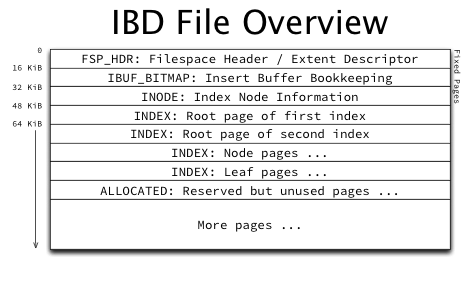
如果对于这个问题感兴趣的话,可以参考 The basics of InnoDB space file layout 中关于“Per-table space files”的描述。可以看到,第四个页面即为INDEX: Root page of first index。
使用vim(:%!xxd)查看时,每行16 Bytes,一个页面就是1024行,第四个页面,即从3073行开始,到4096行结束。
2.2 数据页二进制数据
$ view -b t_r.ibd
3073 0000c000: 646e 9e73 0000 0003 ffff ffff ffff ffff  dn.s............
3074 0000c010: 0000 0007 de81 961e 45bf 0000 0000 0000  ........E.......
3075 0000c020: 0000 0000 01d0 0002 0114 8004 0000 0000  ................
3076 0000c030: 00ce 0002 0001 0002 0000 0000 0000 0000  ................
3077 0000c040: 0000 0000 0000 0000 030c 0000 01d0 0000  ................
3078 0000c050: 0002 00f2 0000 01d0 0000 0002 0032 0100  .............2..
3079 0000c060: 0200 1d69 6e66 696d 756d 0003 000b 0000  ...infimum......
3080 0000c070: 7375 7072 656d 756d 0f03 0000 0010 004e  supremum.......N
3081 0000c080: 8000 0001 0000 0090 f05b bb00 0001 3101  .........[....1.
3082 0000c090: 107a 7a78 8f8a 4b61 3736 6535 6663 3237  .zzx..Ka76e5fc27
3083 0000c0a0: 3839 3961 6461 3131 6234 6561 6664 3062  899ada11b4eafd0b
3084 0000c0b0: 3161 3761 3466 637a 7a78 4065 7861 6d70  1a7a4fczzx@examp
3085 0000c0c0: 6c65 2e63 6f6d 0f03 0000 0018 ffa2 8000  le.com..........
3086 0000c0d0: 0002 0000 0090 f05b bb00 0001 3101 1d79  .......[....1..y
3087 0000c0e0: 6871 8fb8 b262 3662 6463 3864 6364 6465  hq...b6bdc8dcdde
3088 0000c0f0: 6163 6563 6530 3964 3536 3937 3134 3564  acece09d5697145d
3089 0000c100: 3337 3364 3979 6871 4065 7861 6d70 6c65  373d9yhq@example
3090 0000c110: 2e63 6f6d 0000 0000 0000 0000 0000 0000  .com............
3091 0000c120: 0000 0000 0000 0000 0000 0000 0000 0000  ................
3092 0000c130: 0000 0000 0000 0000 0000 0000 0000 0000  ................
     ......
4094 0000ffd0: 0000 0000 0000 0000 0000 0000 0000 0000  ................
4095 0000ffe0: 0000 0000 0000 0000 0000 0000 0000 0000  ................
4096 0000fff0: 0000 0000 0070 0063 646e 9e73 de81 961e  .....p.cdn.s....
3. InnoDB 用户“记录”格式概述
关于该格式的描述,可以参考innobase/rem/rem0rec.c中的注释说明部分,有比较详细的说明。
/*
...
| length of the last non-null variable-length field of data:
  if the maximum length is 255, one byte; otherwise,
  0xxxxxxx (one byte, length=0..127), or 1exxxxxxxxxxxxxx (two bytes,
  length=128..16383, extern storage flag) |
...
| length of first variable-length field of data |
| SQL-null flags (1 bit per nullable field), padded to full bytes |
| 4 bits used to delete mark a record, and mark a predefined
  minimum record in alphabetical order |
| 4 bits giving the number of records owned by this record
  (this term is explained in page0page.h) |
| 13 bits giving the order number of this record in the
  heap of the index page |
| 3 bits record type: 000=conventional, 001=node pointer (inside B-tree),
  010=infimum, 011=supremum, 1xx=reserved |
| two bytes giving a relative pointer to the next record in the page |
ORIGIN of the record
| first field of data |
...
| last field of data |
...
*/
4. InnoDB 页内的记录
在一个页面内,InnoDB存储每条物理记录时,都会在记录中存储一个“指针”,该“指针”指向下一条记录的物理位置,并且在实现时,该“指针”是以当前记录偏移的方式存储的。
所以,如果我们能够找到页面内的第一条记录,那么就可以依此顺序的遍历整个页面内的记录了。找到第一条记录大概有很多的方法,这里说说InnoDB的实现:infimum和supremum。简单来说,InnoDB会在页面中存储一个infimum记录,该记录可以认为是该页面的极小值,该记录中的“Next Record”即为实际的该页面最小值。
4.1 系统记录(system record):infimum 和 supremum
infimum和supremum是每个InnoDB页面内存储两条物理记录,分别代表“起始最小记录”和“结束最大记录”。所以如果使用上述的下一条记录“指针”遍历页内所有记录,则总是从infimum开始,以supremum结束,中间就是所有的用户记录。
在页面找到infimum和supremum记录的方法有两种:
infimum和supremum在页面的偏移,总是99和112- 从
Page Directory的slot中查找:第一个slot总是指向infimum;最后一个slot总是指向supremum
4.2 从Page Directory找到infimum
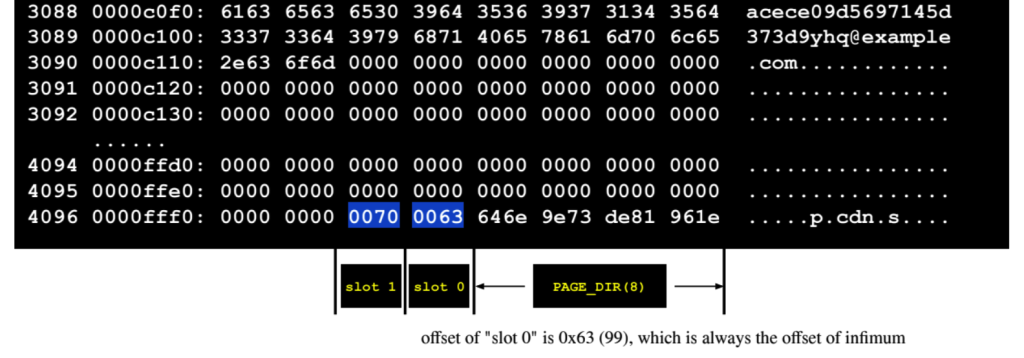
在前文“B+-Tree的内部搜索:InnoDB的实现”,已经概述了slot 0中总是存储的infimum记录,则可以通过页面底部向前偏移PAGE_DIR(InnoDB中PAGE_DIR的值是8),然后找到slot 0对应的记录的偏移,即infimum的偏移,而因为一个slot存储的偏移地址都是2 bytes 。所以,在页面内的倒数第10、9个字节,即为infimum在页内的偏移地址,即0x0063。
4.3 “记录”指针
这里有两点需要注意:
- 一般“记录”指针通常是指向记录的“the origin of the record”,即实际数据开始的地方。不包含“记录头”部分
- 一般“记录”指针会使用两种方式表示:(a) 页内偏移;(b) 相当于当前记录的偏移。不同的地方会不同,例如“记录头”中存储next record的指针则是“相对偏移”,而
slot内存储的则是页内绝对偏移。
理解上述两点,对于理解后续内容是很重要的,要不然,可能会算错地址。
例如,上述的slot 0中记录的infimum的偏移0x0063就是绝对偏移;而infimum中存储的next record偏移,则是相对于infimum的偏移地址。例如,next record偏移是00 1d,那么意味着这条记录的偏移是0x0063+0x001d,即绝对偏移是:0x0080。
4.4 记录头 record header
按照上述方法,这里已经找到第一条(按大小顺序)记录的“记录指针”,即0x0080。把记录的头部(record header)和记录本身数据从上述二进制数据单独取出来,如下:
                                   |<-record header->|
3080 0000c070: ................... 0f03 0000 0010 004e  supremum.......N
               |<---------- field data   ----------->|
3081 0000c080: 8000 0001 0000 0090 f05b bb00 0001 3101  .........[....1.
               ^
               |--> record pointer/offset (the origin of the record)
3082 0000c090: 107a 7a78 8f8a 4b61 3736 6535 6663 3237  .zzx..Ka76e5fc27
3083 0000c0a0: 3839 3961 6461 3131 6234 6561 6664 3062  899ada11b4eafd0b
3084 0000c0b0: 3161 3761 3466 637a 7a78 4065 7861 6d70  1a7a4fczzx@examp
3085 0000c0c0: 6c65 2e63 6f6d ........................  le.com..........
              |<-field data->|
注:
- 在获得了
record pointer后,是无法简单的、直接获得record header长度的,也无法简单的获取记录本身的长度的。而是需要根据元数据库、以及record header中的部分数据,计算而来。 record header的长度获取,是比较复杂的。这里做一定的简化,描述如下:record pointer向前(record header方向)移动,5个bytes是相对固定的,包含了2 bytes: next record3 bits: record type13 bits: the order number of this record4 bits: the number of records owned by this record(slot)4 bits: delete mark and mark a predefined minimum record
record pointer再向前的n个bytes则用于存储null的field,该存储模式为按标记位存储,且按bytes补齐:- 例如,这里一共有
5个fields,则需要1 bytes,作为标记位;如果某个field为null则对应的bit即标记位1 - 所以,这里的
n=1
- 例如,这里一共有
record pointer再向前的m个bytes则用于存储变成列的实际长度。本示例中,共有两个变成列,故这里的m = 2
4.5 记录的解析Record Header
这里以页面中的第一条记录为示例,继续解析该记录的头部信息。详情如下:
(<------------- record header / hex ----------------->) (<----- data/hex ----->)
0f03 0000             0010             004e             8000 0001 0000 0090 f05b

(hex)(<---------------  binary   -------------------->) (<----- data/hex ----->)
0f03 0000000000000000 0000000000010000 0000000001001110 8000 0001 0000 0090 f05b
| |  |<----->|<->|<-->|<---------->|   |<------------>|
| |  |       |   |    |            |   |
| |  |       |   |    |            |   |-->(2 bytes) next record
| |  |       |   |    |            |
| |  |       |   |    |            |-->(3 bits) record type: 000=conventional
| |  |       |   |    |
| |  |       |   |    |-->(13 bits) the order number of this record
| |  |       |   |
| |  |       |   |-->(4 bits) the number of records owned by this record(slot)
| |  |       |
| |  |       |-->(4 bits) delete mark and mark a predefined  minimum record
| |  |
| |  |-->(8 bits) null-flag (here ,no null field at all, 5 field, so 1 bytes )
| |
| |-->(1 byte) length of 1st variable field, so length is 03
|
|-->(1 byte) length of 2nd variable field, so length is 0f(15)
结合记录头部信息,再结合“元数据信息”,则就可以解析出记录本身的信息了。
5. 其他
有很多人对这个问题已经有了非常深入到说明或研究,如下给出主要的参考链接:
- MySQL Documentation: InnoDB Row Formats 非常详细的介绍了多种
InnoDB行格式类型:REDUNDANT、COMPACT 、DYNAMIC 、COMPRESSED等 - Jeremy Cole 2013 The physical structure of records in InnoDB
- Jeremy Cole 2013 The basics of InnoDB space file layout
- Annamalai Gurusami MySQL Blog Archive 2014 Externally Stored Fields in InnoDB
- Heikki Tuuri. Calvin Sun. 2009-04 InnoDB Internals: InnoDB File Formats and Source Code Structure
- Neoreminder 2020 从MySQL InnoDB物理文件格式深入理解索引
- Yungyu 2020 InnoDB — 行记录格式
延伸讨论:
- 各种数据类型的序列与反序列化,以及对应的效率考虑
B+Tree、B+-Tree均指B+-Tree- 一般的,
B-Tree指狭义的、经典的B-Tree,该结构主要参考:了解 InnoDB 的索引结构:B-Tree 基础 - 有时候,
B-Tree也会指代B+-Tree或其他B-Tree变种;这种用法也是非常广泛的,例如,在MySQL/InnoDB的文档中,仅使用B-Tree,而更为准确的说是B+-Tree - “节点”(
Node)、“页面”(Page)、“数据块”、“块”(Block)等均指存储B-Tree或B+-Tree的节点,即树结构的节点,内部可以存储多个键值。在不同的语境下,大家会用不同的词,例如通常在算法课程/书籍中,会更多的使用“节点”(Node);而在数据库实现中,则更喜欢用“页面”(Page)或“块”(Block);更为细节的,如果在内存中,则更多的时候用“页面”(Page),在磁盘上,则更多的“块”(Block)。各种情况下混用的也很多,并没有什么问题。 - “记录”(record)、“行”(row)、tuple都是表示表中的一行记录,通常包含多个字段数据。
- 索引入口(
Entry)等是指完整的“键值对”,在叶子节点中,通常包括\( (k_i, a_i) \);在非叶子节点中可能的形式是:\( (k_i,p_i, a_i) \) 或 \( (k_i, p_i) \) TAOCP是 “The Art of Computer Programming”的缩写
Leave a Reply